
IG1252 evaluation methodology: how autonomous network levels are scored
IG1252 is the TM Forum methodology that turns task ratings into an autonomous network level for a given scenario. Each task is rated from L0 to L5 through the IAADE steps, and the ratings are combined into a scenario result expressed as Lbase, Lextra and Lscenario.
This page explains the logic in our own words. IG1252 itself is reserved for TM Forum members, so we do not reproduce it: the reference is the official IG1252 v1.2.0 page on the TM Forum website.
What IG1252 defines
TM Forum describes autonomous networks on a scale from L0, manual operations, to L5, fully autonomous networks (see AN levels L0 to L5). A scale alone does not tell you how to rate a real network. IG1252, the Autonomous Network Levels Evaluation Methodology, fills that gap. According to the TM Forum AN resources page, the current version, v1.2.0, was approved on 16 June 2023.
The TM Forum Level 4 industry blueprint (November 2024) summarises what the methodology covers: the evaluation approach and operation flows, the task evaluation criteria and the scoring method. In practice, IG1252 answers three questions:
- What is evaluated. The evaluation object is a scenario, such as RAN fault management, not a whole network. TM Forum calls these high value scenarios (HVS).
- How a task is rated. Each task is judged against level criteria, step by step through the IAADE cycle.
- How ratings are combined. Task ratings roll up into a single result for the scenario.
IG1252 works together with ANLET, the Autonomous Network Level Evaluation Tool. ANLET provides the scenario questionnaires, published as spreadsheets in the GB1059 series; IG1252 gives the method behind them. Since June 2025, the TM Forum ANLAV service has added a third step: certified evaluators can submit an ANLET evaluation for independent validation, as reported by TM Forum Inform.
Scoring per task and per sub-scenario
A scenario is split into sub-scenarios that group related tasks. The task is the smallest unit that receives a level.
For each task, the evaluator looks at the five IAADE steps: Intent, Awareness, Analysis, Decision and Execution. The question at each step is the same: is the work done by people, by systems, or by both? The more steps are carried out by systems, the higher the level. Execution is usually automated first. Intent is handed over last, and fully only at L5.
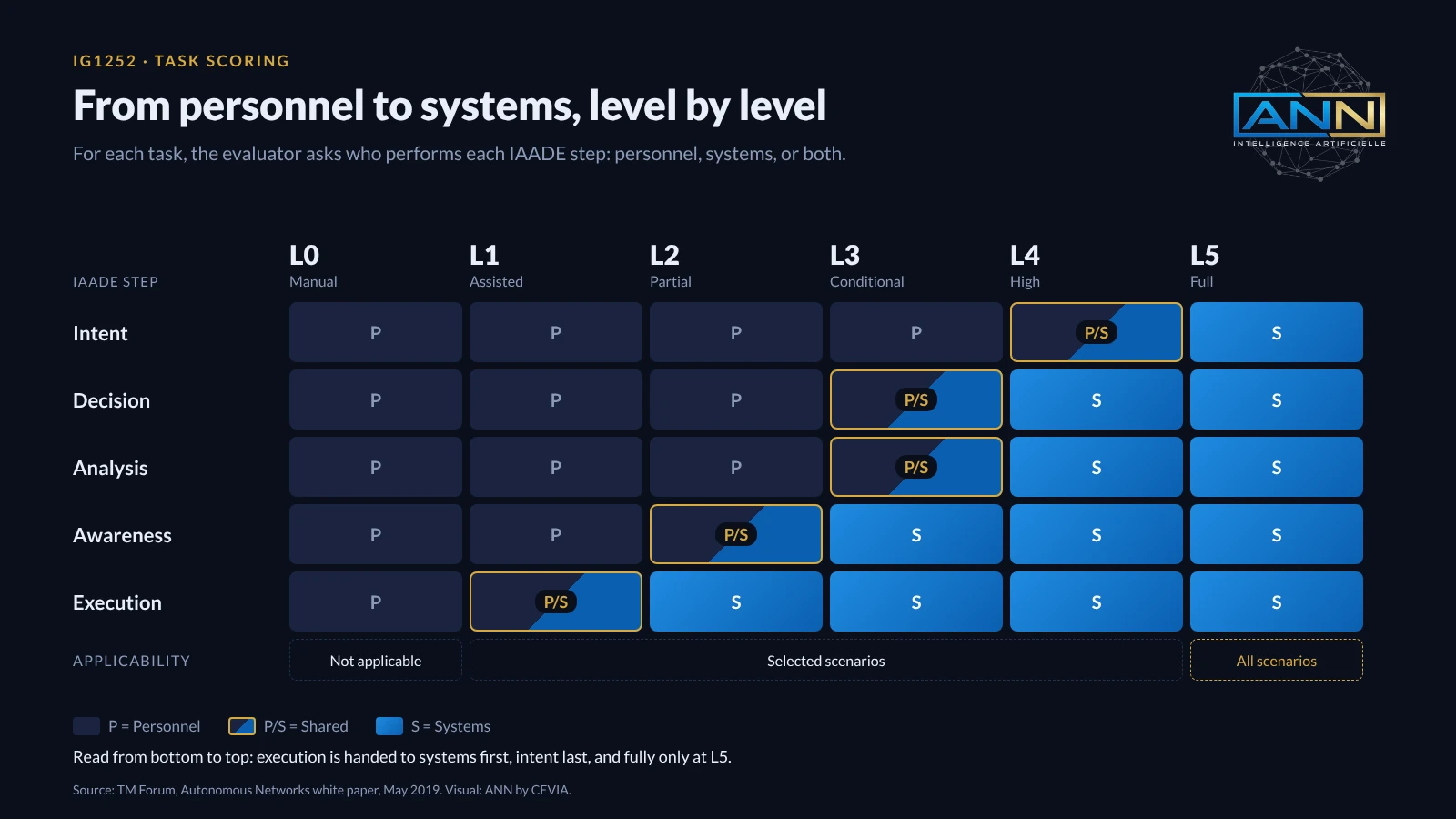
Tasks do not all weigh the same. The blueprint explains that the assessment questionnaires build on grading standards from bodies such as 3GPP and ETSI, with added weighting and detailed scoring criteria. Its sample question carries a weight of 5 % for data collection. A task that matters more to the scenario therefore counts more in the result.
Within a sub-scenario, the task ratings show where work is already automated and where people still carry it. Across sub-scenarios, they are combined into the scenario result.
The blueprint is also candid about limits. In November 2024, detailed scoring for specific domains and scenarios had not been fully standardised, and the first pilot results showed that the questionnaires needed refinement to allow normalised scoring. This is why a level should always be read together with its scenario, its questionnaire and its evidence.
Lbase, Lextra and Lscenario
IG1252 expresses a scenario result in three values. In our own words:
| Value | What it tells you |
|---|---|
| Lbase | The base level reached by the scenario's tasks. The weakest capability holds it back. |
| Lextra | Additional credit for tasks that already go beyond the base level. |
| Lscenario | The resulting level of the scenario, combining Lbase and Lextra. |
Why split the result in two parts? A plain average would hide the weak points. Imagine a scenario where most tasks run at L4 but alarm intake is still manual. An average could come close to Level 4, while daily operations still depend on people at that step. Separating the base from the extra credit keeps both facts visible: the level the whole scenario can rely on, and the progress already made above it.
This also explains why results are often read with decimals. In phase 2 of the TM Forum pilot described in the blueprint, the average score for fault management was 2.5 in the core network and 2.8 in the RAN: most operators were between Level 2 and Level 3.
The exact rules for computing Lbase and Lextra, including weights and thresholds, are set out in IG1252 and in each ANLET questionnaire. We do not reproduce them here.
A worked example (fictive)
The example below was built by CEVIA to show the mechanics. The sub-scenario, tasks, weights and levels are invented; the results are those ANN would compute for these answers. It is not an extract from IG1252 or from an ANLET questionnaire.
Take a fictive sub-scenario, "Alarm handling", with five tasks:
| Task (fictive) | Weight | Level |
|---|---|---|
| Collect alarms from all network elements | 15 % | L4 |
| Filter and deduplicate alarms | 20 % | L3 |
| Correlate alarms to a probable root cause | 30 % | L3 |
| Decide on the corrective action | 20 % | L2 |
| Execute and verify the fix | 15 % | L3 |
Reading it step by step:
- Lbase. The weakest task, deciding on the corrective action, is at L2. The base level is therefore Level 2: this is what the whole sub-scenario can rely on.
- Lextra. Tasks representing 80 % of the weight already work above L2. The extra credit is therefore 0.8.
- Lscenario. Combining both gives 2.8: Level 2, close to Level 3.
Now suppose the team raises the decision task to L3. The base moves to Level 3, and only alarm collection (15 % of the weight) remains above it. The result becomes 3.15.
The lesson is clear. Pushing alarm collection from L4 to L5 would barely move the result. Lifting the weakest task changes the base level. This is what the gap list is for: it points to the tasks that hold the scenario back.
Why "Not assessed" is never zero
A missing answer is not a bad answer. If a task has not been rated yet, counting it as L0 would distort the result. In the example above, an unrated "Execute and verify the fix" counted as L0 would drag the base down to Level 0, even though nothing says the task is manual.
So a task without an answer is marked Not assessed and left out of the calculation, instead of being scored as zero. In ANN, it shows a grey "Not assessed" badge, never a zero or a failure status. While any sub-scenario is incomplete, the overall score also displays "Not assessed" rather than a number, to avoid a misleading figure.
The same caution applies to AI. In ANN, an AI pre-filled answer counts toward no score until a person validates it or picks a level manually.
How ANN applies IG1252
ANN uses IG1252 as the scoring method behind its questionnaires:
- Questionnaires by scenario. Each of the scenarios currently available in ANN, listed on the scenarios page, is organised in tabs by sub-scenario, then by task, rated from L0 to L5 through the IAADE steps. Examples include RAN fault management (GB1523A) and RAN energy efficiency optimization (GB1526A).
- Scenario result. The results screen shows Lbase, Lextra and Lscenario following IG1252, an IAADE maturity radar and a list of gaps per sub-scenario. The gap list feeds the roadmap, whose first phase is closing the critical gaps.
- Source of each questionnaire. Each scenario states where its questionnaire comes from: a real ANLAV report where one exists, or a reconstruction documented by CEVIA from published TM Forum questionnaires. A reconstruction is never presented as an official TM Forum table.
- Evidence, kept apart from the score. Each task can carry declarative or technical evidence. ANN shows an evidence coverage rate in which technical evidence counts in full and declarative evidence alone counts half, with a default coverage threshold of 80 %. This weighting is a CEVIA method, not a TM Forum rule, and it never changes Lscenario.
A self-assessed level, even computed carefully, is not a validation. Under ANLAV, a certified evaluator submits the evaluation and TM Forum validates it. To see what that involves, read how to prepare for ANLAV.
Related reading: AN levels L0 to L5 for the scale itself, What is ANLET? for the questionnaires, and the glossary for every term used on this page.