
Autonomous Network Levels L0 to L5: what Level 4 means
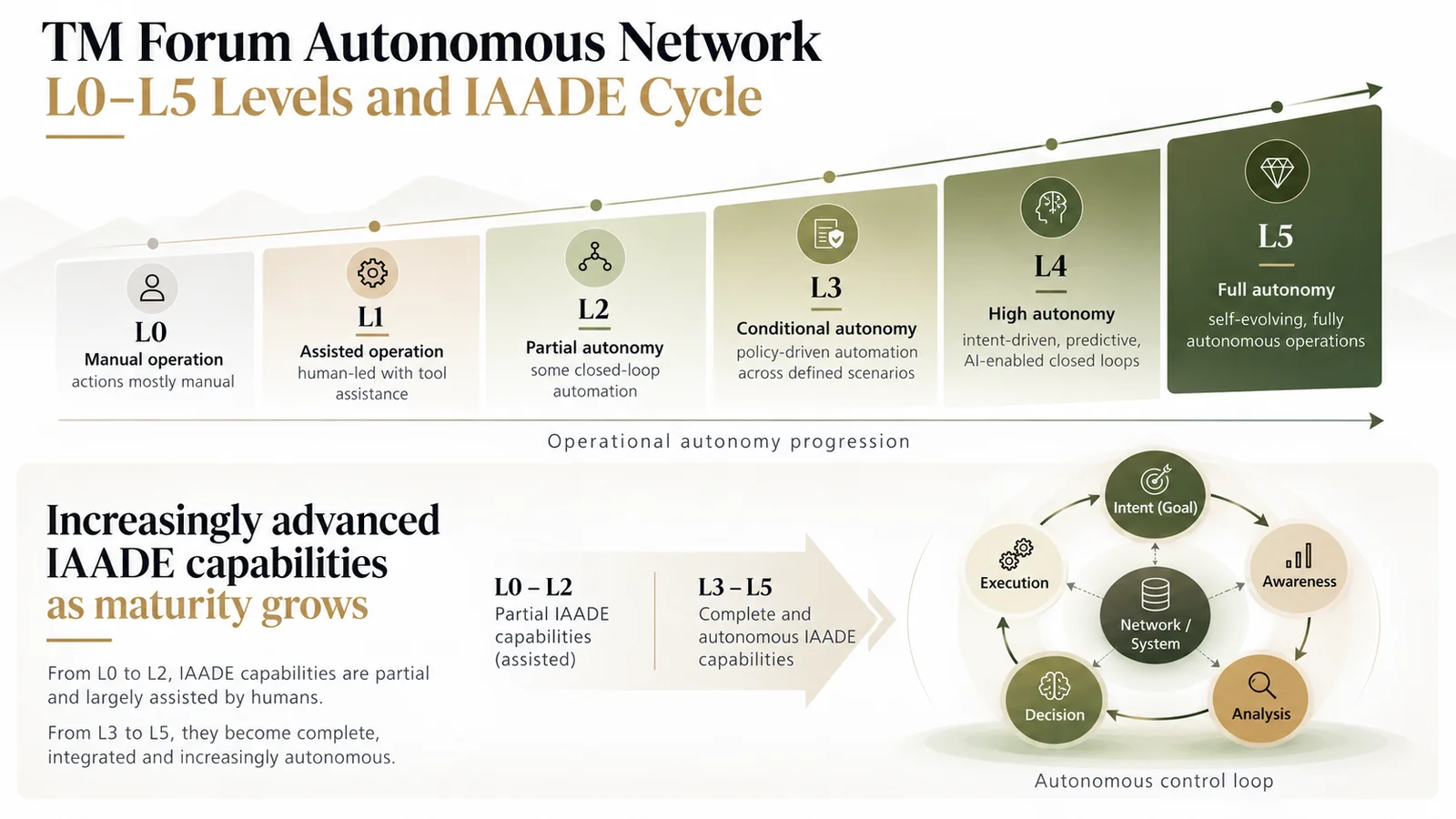
TM Forum defines six Autonomous Network Levels, from L0 (manual operations) to L5 (a fully autonomous network), and Level 4 is the milestone TM Forum has set for key operational domains. A level is never given to a whole network: it is assessed scenario by scenario, task by task, with the IAADE cycle and the IG1252 methodology, and it can then be independently validated through ANLAV.
What the six levels mean
TM Forum classifies AN Levels from Level 0 to Level 5, from manual management to fully autonomous networks. What separates one level from the next is simple to state: which tasks are still performed by people, which ones are handed to systems, and across how many domains.
| Level | TM Forum name | In practice |
|---|---|---|
| L0 | Manual operation and maintenance | The system helps with monitoring; every dynamic task is done by people. |
| L1 | Assisted operation and maintenance | The system runs some repetitive, pre-configured sub-tasks. People still drive the work. |
| L2 | Partial autonomous network | Closed loops exist for specific units, often based on AI models, in a known environment. |
| L3 | Conditional autonomous network | The system senses changes in real time and adjusts itself within a given domain, guided by intent. |
| L4 | High autonomous network | The system analyses and decides on its own across domains, with predictive closed loops driven by service and customer experience. |
| L5 | Full autonomous network | Closed-loop automation across services, domains and the whole lifecycle. The long-term goal. |
The level names come from TM Forum's Autonomous Networks white paper. The right-hand column is our own summary.
Why levels are assessed per scenario (HVS)
No operator runs a single network with a single level of autonomy. Fault management on the radio access network can be close to self-healing while change management in the core still relies on tickets and manual approvals. A single "network level" would hide both.
TM Forum therefore assesses levels per High Value Scenario, or HVS: a defined operational use case such as RAN Fault Management (GB1523A) or RAN Energy Efficiency Optimization (GB1526A). As TM Forum puts it, AN Level evaluations for specific scenarios are carried out with standardised evaluation tools published as questionnaires.
Each scenario is split into sub-scenarios, and each sub-scenario into tasks. The outcome is a profile: a level per scenario, with the detail of what holds it back. This has two practical consequences:
- A Level 4 claim is always tied to a named scenario. "We are Level 4" means little without it.
- Progress is planned scenario by scenario. Operators usually start with the scenarios where automation already exists and the business case is clear.
The scenarios currently available in ANN are listed on the scenarios page. Others from the catalogue are marked as coming soon and will be added over time.
The IAADE cycle behind each level
Every task in a scenario is looked at through five cognitive steps, known as IAADE:
- Intent: understanding what the business wants, expressed as goals rather than commands.
- Awareness: knowing the current state of the network and services.
- Analysis: understanding causes, trends and what is likely to happen next.
- Decision: choosing the action to take.
- Execution: carrying the action out.
The levels describe how these steps move from people to systems. TM Forum's white paper shows the progression in a simple matrix, where P stands for personnel and S for systems:
| Step | L0 | L1 | L2 | L3 | L4 | L5 |
|---|---|---|---|---|---|---|
| Execution | P | P/S | S | S | S | S |
| Awareness | P | P | P/S | S | S | S |
| Analysis | P | P | P | P/S | S | S |
| Decision | P | P | P | P/S | S | S |
| Intent | P | P | P | P | P/S | S |
Read it from bottom to top. Automation starts with execution, then reaches awareness, then analysis and decision. Intent is the last step to be shared with systems, and it is only fully handed over at L5.
What Level 4 changes in operations
At Level 4, analysis and decision are performed by systems for the scenario in question. People no longer approve each corrective action. They set the intent, define the boundaries, and supervise the outcome.
Three changes stand out in day-to-day operations:
- From reaction to anticipation. Closed loops act on predictions, not only on alarms that have already fired.
- From one domain to several. Level 4 works in a cross-domain environment, where a decision in the radio network can take the transport or core layers into account.
- From network metrics to experience. The loops are driven by service quality and customer experience, which matches the TM Forum vision of zero wait, zero touch, zero trouble services.
Level 4 is also where the human role becomes more demanding, not less. Teams must be able to express intent clearly, trust the data the system relies on, and show, with evidence, how decisions are made, in particular during an ANLAV validation. That is why evidence matters as much as technology.
How a level is measured (ANLET, IG1252) and validated (ANLAV)
Three TM Forum references work together.
IG1252, the evaluation methodology
IG1252 is the TM Forum document that defines how autonomous network levels are evaluated. In our own words: each task of a scenario is rated on the L0 to L5 scale across the IAADE steps, and the task results are combined into a score for the scenario. IG1252 is reserved for TM Forum members, so we do not reproduce it here. Our IG1252 page explains the logic in more detail.
ANLET, the evaluation questionnaires
The Autonomous Network Levels Evaluation Tool (ANLET) turns the methodology into scenario-based questionnaires. It gives a consistent and repeatable way to state a level for a given scenario. See our ANLET page.
ANLAV, the independent validation
ANLAV, the AN Level Assessment and Validation service, was launched by TM Forum at DTW Ignite in June 2025. Operators submit their ANLET evaluation data to the TM Forum, which validates it after a panel review. TM Forum accepts these assessments only from evaluators trained through its AN Levels skill path.
Where ANN fits
ANN covers the preparation work before validation. It structures the questionnaire by sub-scenario and IAADE step, proposes AI suggestions that count only once a person validates them, records typed evidence (declarative or technical), builds a roadmap from the gaps, and exports an evidence pack. The validation itself stays with the TM Forum (ANLAV). Our ANLAV readiness page details what the TM Forum expects from a submitted file.
Where operators stand today
Level 4 has moved from target to first results.
- First validated Level 4. On 19 June 2025, Ericsson and TDC NET announced that Ericsson's Predictive Cell Energy Management, running in TDC NET's live network in Denmark, had been rated Level 4 by TM Forum under ANLAV, on the RAN Energy Efficiency Optimization scenario. It was presented as an industry first.
- An industry milestone. TM Forum CEO Nik Willetts recalled that the Forum had set the milestone for operators to reach Level 4 in key domains in 2025.
- Still early for most. At DTW Ignite 2025, Rahul Kumar of IBM Consulting noted that only 6 percent of CSPs say they have Level 4 autonomous networks.
The lesson from these first results is consistent: Level 4 is reached scenario by scenario, from a measured starting point. TM Forum describes this progression as the AN Journey, which is specific to each operator and starts from a current baseline.
A good first step is to pick the scenario where your automation is most advanced, for example RAN Energy Efficiency Optimization or RAN Fault Management, and measure where each task really stands. The glossary and the FAQ cover the remaining terms and questions.